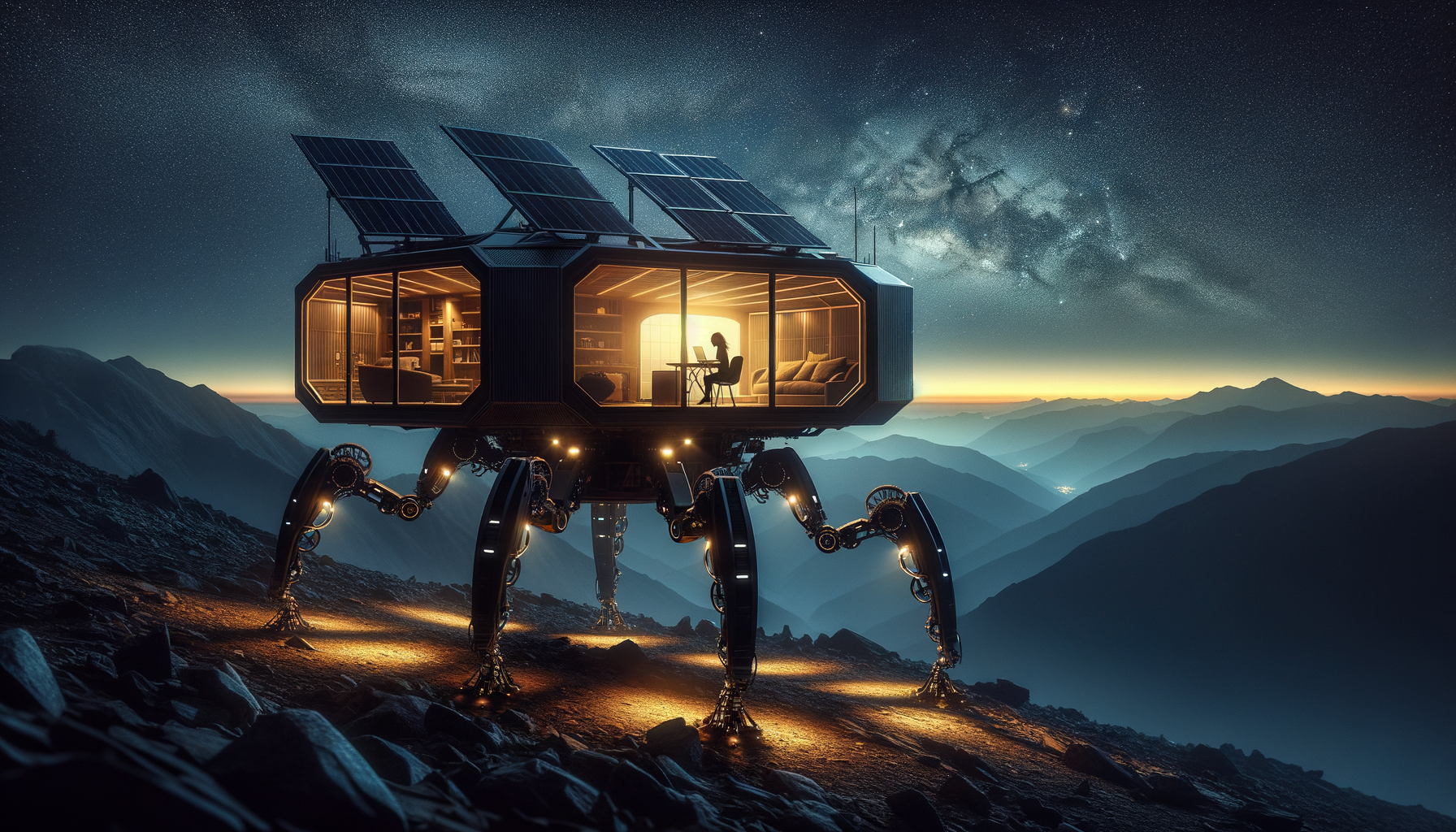
ROBOTIC OFF-GRID AUTONOMOUS MOVER

Wake up in the Amazon.
Walk to the mountains.
Live anywhere on Earth.

A terrain-independent hexapod mobile habitat. No roads. No wheels. No infrastructure. Just six legs and the entire planet.

01 / THE PROBLEM

Roads are a 20th century assumption.

Global demographics are collapsing. Birth rates have fallen below replacement in most developed nations. The road infrastructure built for 8 billion people won't be maintained for 6 billion. We need vehicles that don't depend on roads.

64M km
of paved roads worldwide, requiring constant maintenance that shrinking populations can't sustain.
2.1
replacement fertility rate. Most developed nations are now below 1.5. South Korea hit 0.72 in 2023.
71%
of Earth's surface is water. Of the remaining 29%, most is inaccessible by wheeled vehicles.
400M
years of evolution optimized legged locomotion. Insects solved terrain-independence with six legs.

02A / THE VEHICLE

A walking home.

Six hydraulic legs carrying a self-leveling habitable cabin. Solar-powered, hydrogen-backed, AI-navigated. Designed for one: the solo explorer who wants total freedom.

ROAM hexapod leg mechanism detail

Hexapod Chassis

Six adaptive hydraulic legs with 18+ degrees of freedom. Each foot conforms to rock, mud, sand, ice, and vegetation.

Solar Array

Retractable photovoltaic deck. 8-12 m² deployed surface. Powers all systems in daylight conditions.

Habitat Module

12-15 m³ living space. Panoramic windows. Self-leveling cabin up to 30° slope.

Adaptive Hooves

Terrain-conforming rubber pads with retractable crampon inserts for ice and rock.

H₂ Fuel Cell

Hydrogen power for extended range. 72-hour autonomous operation without solar.

Water System

200L storage. Atmospheric generation. Greywater recycling at 80% recovery rate.

Terrain AI

LiDAR + neural terrain classification. Energy-optimal pathfinding. Learns from every step.
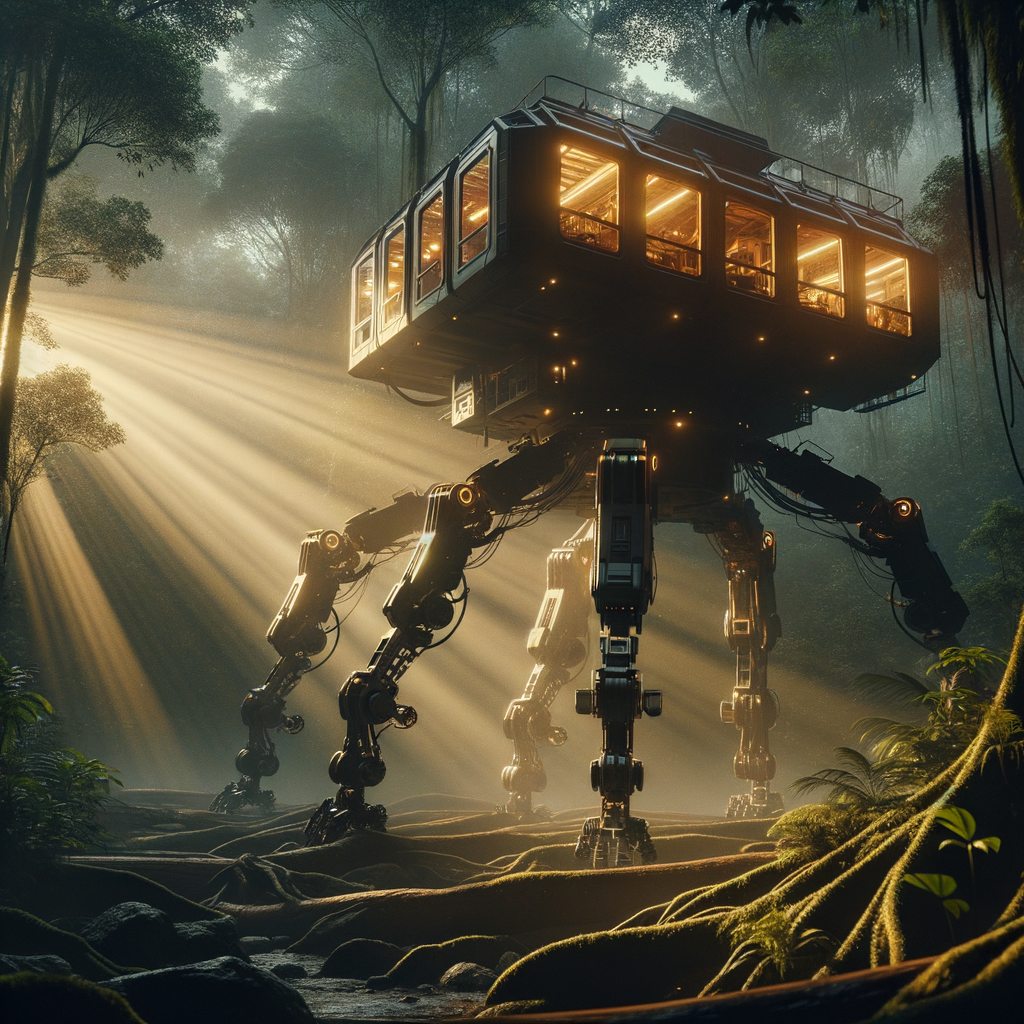
ANY TERRAIN. ANY SEASON.

02B / ENGINEERING JUSTIFICATION

Six legs isn't aesthetic. It's engineering.

We evaluated biped, quadruped, hexapod, and octopod configurations against five criteria critical for a habitable walking vehicle. Hexapod won on every metric that matters for human safety in wilderness conditions.

METRIC BIPED QUADRUPED HEXAPOD OCTOPOD
Static Stability Low Medium High High
Walking Speed Slow Medium Fastest No gain
Fault Tolerance None Poor Good Better
Control Complexity Very High Low High Very High
Multi-function Legs No Limited Yes Overkill
3-Point
Alternating tripod gait keeps three legs grounded at all times, forming a stable triangle. The cabin stays level. Nature tested this design on insects for 400 million years.
Fault Safe
Lose a leg on a quadruped: 25% capacity gone, unstable. Lose a leg on a hexapod? Switch to pentapod gait and walk home safely. In the wilderness, redundancy isn't optional.
Optimal
Research confirms six legs is the speed optimum for legged locomotion. More than six adds weight and complexity without increasing speed. (Alexadre et al, 1991; Frontiers in Robotics, 2024)
Dual Use
Spare legs double as manipulators: anchoring to hillsides, lifting cargo, stabilising the platform on a slope. Quadrupeds need all four legs just to stand.

Sources: Frontiers in Robotics & AI (2024), ScienceDirect Mechanism Design (2022), Alexadre et al (1991), IMF Working Papers on legged vehicle dynamics.

02C / INTERIOR PHILOSOPHY

Designed for living, not for showrooms.

Human living creates waste, moisture, dirt, and wear. Every interior surface is designed for reality: easy to clean, modular enough to replace, and manufacturable with 3D printing for field repairs.

EASY-CLEAN

Zero Dead Corners

All interior joints are rounded. No 90-degree angles where dirt accumulates. Non-porous antimicrobial surfaces. Seamless floors with integrated drainage slopes. Snap-fit wall panels remove for deep cleaning.

3D PRINTABLE

Print. Replace. Continue.

Interior modules designed as discrete printable units with standard connection interfaces. Damaged part? Print a new one onboard or at resupply. Materials: recycled PETG, ASA, carbon-fiber reinforced nylon.

WASTE MANAGED

Closed Loop Living

Composting toilet (zero water waste). Greywater recycling with 80% recovery. Solid waste compaction and sealed storage. Organic composting feeds optional hydroponics module.

COCKPIT Navigation + Work Desk LIVING MODULE Convertible Bed + Lounge Bed / Sofa Table WET MODULE Kitchen + Shower + Toilet Kitchen Shower Composting Toilet MECHANICAL DECK: Water Tanks · H2 Cells · Batteries · Waste Storage · Tools Target: 12-15 m3 interior · 2000-2500 kg cabin · 1.9m ceiling · Self-leveling to 30 degrees
ROAM interior concept, compact habitat with warm amber lighting

03 / CORE SUBSYSTEMS

Every system earns its weight.

At 2-3 tons total mass, every kilogram matters. Each subsystem is designed for maximum autonomy with minimum weight. Field-repairable. Redundant where it counts.

LOCOMOTION

Adaptive Hexapod Gait

Six hydraulic legs with 3 DOF each. Alternating tripod gait for speed, wave gait for stability. Terrain-adaptive foot placement via depth cameras and force feedback.

NAVIGATION

Terrain-Aware AI

LiDAR + stereo cameras + satellite terrain data. Neural terrain classification for surface type, slope, and obstacle detection. Path planning optimized for energy efficiency.

POWER

Solar + Hydrogen Hybrid

Roof-mounted solar array for daily power. Hydrogen fuel cells for cloudy days and high-demand locomotion. Regenerative braking on downhill sections recovers energy through leg hydraulics.

WATER

Atmospheric + Recycled

Atmospheric water generation (AWG) extracts moisture from air. Multi-stage filtration for natural water sources. 80% greywater recycling. Target: 20L/day self-sufficient.

COMMS

Always Connected

Starlink terminal for global internet. Mesh networking with other ROAM units. Emergency beacon (EPIRB). Offline-first architecture. All critical systems work without connectivity.

AI BRAIN

AION Integration

Connected to AION ecosystem for memory, learning, and coordination. Pilgrim researches new routes. Laila handles voice commands. All decisions logged and learnable.

04 / APPROACH

Software first. Hardware when ready.

We're not building a robot in a garage. We're building the intelligence that drives it: terrain classification, gait optimization, energy management, path planning. All in simulation. When the software can navigate any terrain in a digital twin, we build the body.

Phase 1
Concept validation. Research hexapod dynamics, terrain classification, and power systems. Build the knowledge base in AION memory. Current phase.
Phase 2
Simulation. ROS2 + Gazebo hexapod model. Train terrain navigation AI. Validate gait patterns and energy budgets in virtual environments.
Phase 3
Scale model. Build a 1:4 scale hexapod to validate real-world locomotion, power consumption, and sensor integration.
Phase 4
Full prototype. Purpose-built hexapod chassis with habitable cabin. First wilderness traversal.